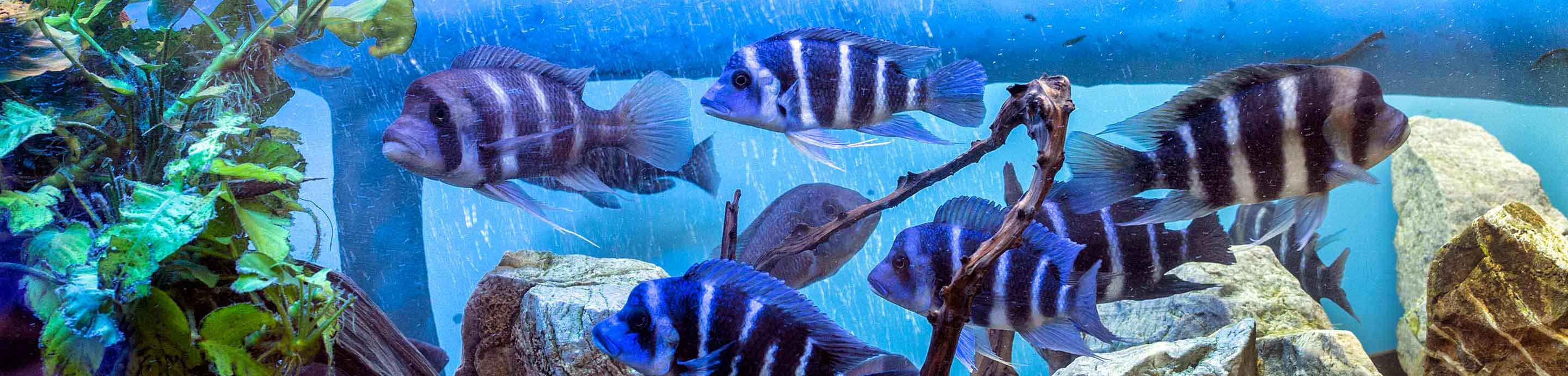


Copadichromis azureus
by Marc Elieson
This striking and stunning Utaka is found in Lake Malawi around Mbenji Island, although some have reportedly been seen around Nakantenga Island. This fish prefers the open water, and in the wild is often found at depths of 15 - 23 meters.
![Image]()
Consequently, thisspecies needs a tank with lots of swimming space, and should be no shorter than 5 ft. It is a rather peaceful and hardy fish. The only aggression I have seen is when the male is preparing to spawn, and even then, his aggression is more show than anything else. If other fishes of this species are in the same tank, they sometimes school together. The best tank mates for this species are not other Utaka because of the probability of cross-hybridization. Females of this genus are difficult to distinguish. Peacocks and Cyrtocara moorii make great tank mates in my opinion. Mbuna are too aggressive for this milder species, unless you have a large and long tank.
Males reach sizes of 16 - 17 cm (or 6.5 inches), while females are considerably smaller (12 - 13 cm). Only males take on the striking electric blue coloration (these pictures really do not do this fish justice--trust me!). Females remain silver with three dark spots on their sides. Like all utaka, this species feeds on zooplankton in the wild, but will readily feed on most anything in captivity. Spirulina flakes are recommended.
This cichlid is often sold under the name Haplochromis chrysonotus but should not be confused with Copadichromis chrysonotus, a distinctly different fish. Haplochromis chrysonotus is an older name for C.azureus.
![Image]()
A note of caution: because this fish is not extremely aggressive, similar-appearing fish (like other Auloncara and Sciaenochromis) may cross-breed with his female (who very closely resembles females of these other species). Therefore, caution should be used if these fishes are to co-habitate in an aquarium. Make sure the aquarium is long and that each male is provided with at least one female; if not, none of them should be provided with a female mate.
![Image]()
by Marc Elieson
This striking and stunning Utaka is found in Lake Malawi around Mbenji Island, although some have reportedly been seen around Nakantenga Island. This fish prefers the open water, and in the wild is often found at depths of 15 - 23 meters.
Consequently, thisspecies needs a tank with lots of swimming space, and should be no shorter than 5 ft. It is a rather peaceful and hardy fish. The only aggression I have seen is when the male is preparing to spawn, and even then, his aggression is more show than anything else. If other fishes of this species are in the same tank, they sometimes school together. The best tank mates for this species are not other Utaka because of the probability of cross-hybridization. Females of this genus are difficult to distinguish. Peacocks and Cyrtocara moorii make great tank mates in my opinion. Mbuna are too aggressive for this milder species, unless you have a large and long tank.
Males reach sizes of 16 - 17 cm (or 6.5 inches), while females are considerably smaller (12 - 13 cm). Only males take on the striking electric blue coloration (these pictures really do not do this fish justice--trust me!). Females remain silver with three dark spots on their sides. Like all utaka, this species feeds on zooplankton in the wild, but will readily feed on most anything in captivity. Spirulina flakes are recommended.
This cichlid is often sold under the name Haplochromis chrysonotus but should not be confused with Copadichromis chrysonotus, a distinctly different fish. Haplochromis chrysonotus is an older name for C.azureus.
A note of caution: because this fish is not extremely aggressive, similar-appearing fish (like other Auloncara and Sciaenochromis) may cross-breed with his female (who very closely resembles females of these other species). Therefore, caution should be used if these fishes are to co-habitate in an aquarium. Make sure the aquarium is long and that each male is provided with at least one female; if not, none of them should be provided with a female mate.


